
Remember me

The growing aging population in developed countries has led to increased societal and economic burdens [53] (https://www.who.int/news-room/fact-sheets/detail/ageing-and-health), highlighting the urgent need for therapies that support healthy aging. One promising research area focuses on botanical extracts which are rich in phytoconstituents and have the potential to be developed into agents that enhance healthspan. Compounds derived from natural sources that target key aspects of cellular aging have been shown to improve both healthspan and lifespan in various models, including cell cultures [54], invertebrates, rodents, and humans [27]. These phytochemicals act as geroprotective agents by reducing oxidative stress, promoting cellular repair, and eliminating senescent cells in tissues, improving age-related physiological phenotypes, and acting as “senomorphics” to inhibit inflammation and immune senescence [27]. Consequently, botanical extracts are a valuable area of study for developing treatments that can help mitigate the societal and economic impacts of an aging population [54]. Reducing oxidative stress—a central factor in cellular aging and degenerative diseases—preventing telomere damage and modulating DNA methylation have been demonstrated to create a healthier tissue environment [55,56,57]. This, in turn, decreases low-grade inflammation, which drives age-related diseases [58]. The observed geroprotective effects of Monarda didyma L. extract in both in vitro studies and the clinical trial, particularly its role in mitigating oxidative stress and inflammation—likely mediated by its principal flavonoid DID [28, 32, 33, 59]—highlight its potential as an anti-aging dietary supplement to promote health in aging populations. The prominent presence of DID establishes it as the primary candidate responsible for the extract’s observed geroprotective effects.
In vitro studies on Monarda didyma L. extractIn the present study, we describe a natural extract that displays in vitro antioxidant properties, slows the rate of telomere shortening, and protects against DNA damage with reduction of cellular senescence and improvement of endothelial function and vascular permeability.
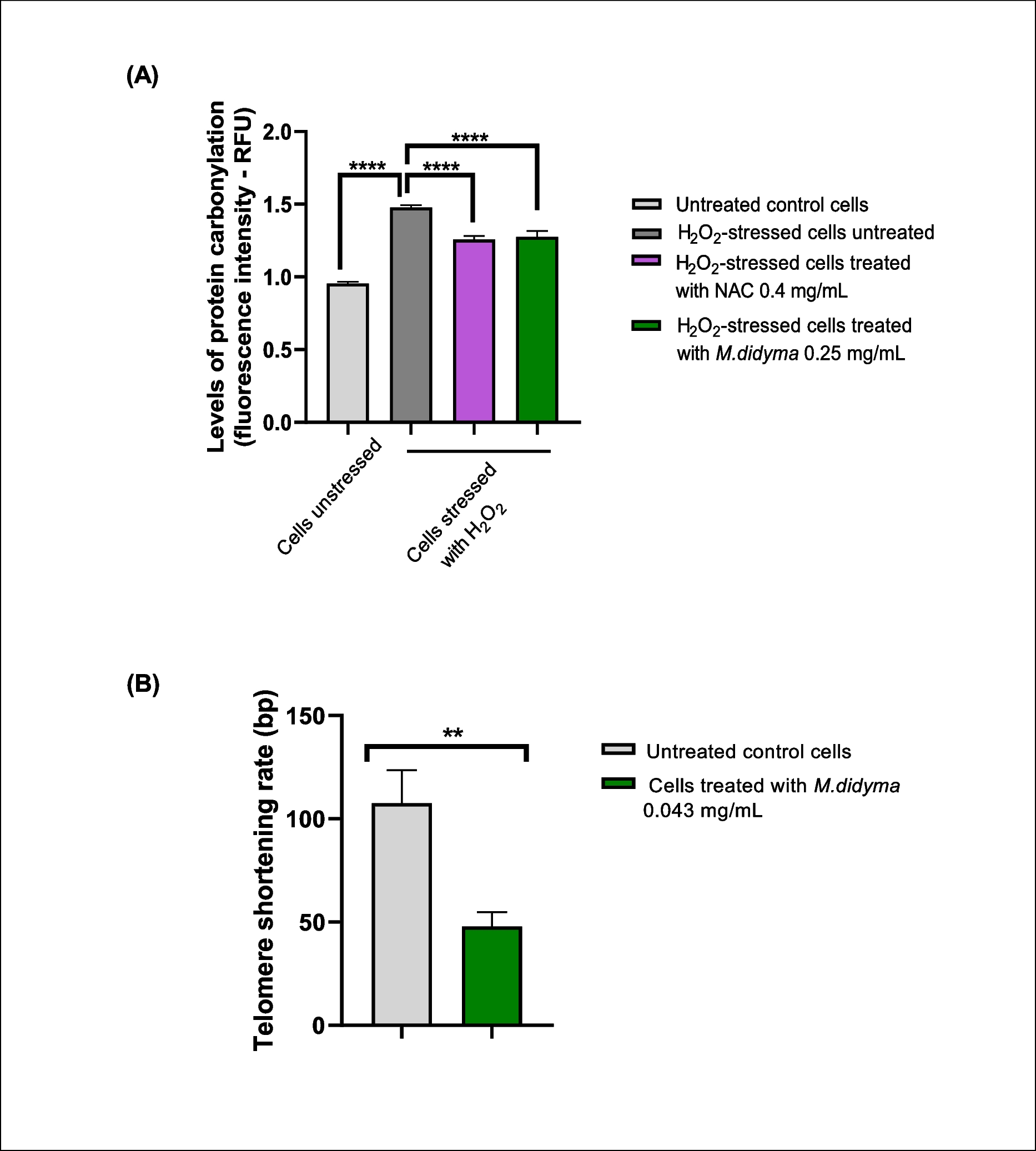
Antioxidant propertiesThe Monarda didyma L. extract’s strong antioxidant properties were evident, as demonstrated by its capacity to reduce protein carbonylation levels. This antioxidant activity is essential in combating oxidative stress, a major contributor to cellular aging and various degenerative diseases [7]. The ability to reduce oxidative damage further supports the extract’s role in promoting cellular health and longevity.
Slowing telomere shortening rateCells treated with the Monarda didyma L. extract for 6 weeks showed a significant reduction in the rate of telomere shortening compared to untreated control cells. It can be hypothesized that the molecules found in Monarda didyma L. extract play a significant role in safeguarding DNA from damage. Certain polyphenols are renowned for their ability to stabilize and protect the DNA structure, including telomeres. By shielding DNA from harm, these molecules may help mitigate the wear and breakage of telomeres during cellular replication [60]. Moreover, Monarda didyma L. extracts exhibit potent antioxidant properties, capable of reducing oxidative stress within cells [54]. Oxidative stress is a major contributor to telomere shortening, as free radicals can inflict damage on DNA, telomeres included [61]. Furthermore, the activation of telomerase by Monarda didyma L. as a possible mechanism remains unverified at this time.
The biological significance of the finding that Monarda didyma L. extract can slow telomere shortening is important for understanding aging and cellular health. Telomeres are protective caps at the ends of chromosomes that shorten with each cell division, leading to cellular aging and senescence when they become too short [45]. By slowing telomere shortening, Monarda didyma L. extract may extend the lifespan of cells, helping to maintain tissue function and delay age-related decline. This has several key implications including extending cellular lifespan as cells can divide more times before reaching senescence, thus maintaining tissue health longer; delaying age-related diseases as slower telomere shortening can delay the onset of diseases linked to aging, such as cardiovascular diseases, neurodegenerative disorders, and certain cancers [12]. Improving regenerative capacity as tissues that regenerate frequently, like skin and blood, can benefit from enhanced repair and regeneration. Monarda didyma L. extract shows significant promise as a gerotherapeutic agent by slowing telomere shortening and targeting cellular aging processes. Developing it into a therapy could promote longevity and enhance quality of life, highlighting its broad implications for health and well-being.
Protection against DNA damageThe Monarda didyma L. extract induces a reduction in γH2A.X and H3K9me3 levels in genotoxically stressed cells. γH2A.X is a marker of DNA double-strand breaks [62], while H3K9me3 is associated with chromatin changes following DNA damage [63]. Lower levels of these markers indicate reduced DNA damage and improved DNA repair mechanisms [63, 64].
By protecting DNA from damage, the extract plays a crucial role in maintaining genomic stability. Genomic instability is an early hallmark of cellular aging [2]. It can lead to mutations, loss of genetic information, and chromosomal abnormalities, all of which are linked to cancer and other diseases. DNA damage also contributes to cellular senescence and aging [12]. Therefore, by reducing DNA damage, the extract may help prevent premature aging, promoting healthier cell function and longevity.
This protective effect underscores the extract’s potential as a valuable agent in safeguarding genomic integrity. The significant reduction in DNA damage markers highlights the extract’s role in maintaining genomic stability and mitigating the adverse effects of cellular aging.
Reduction in cellular senescenceThe extract significantly reduced cellular senescence, as indicated by decreased SA-β-galactosidase activity in aged cells. SA-β-galactosidase (senescence-associated β-galactosidase) activity is a widely used biomarker to identify senescent cells [65]. High levels of SA-β-galactosidase activity are typically present in aged or senescent cells [66]. Therefore, a decrease in SA-β-galactosidase activity suggests a reduction in the number of senescent cells. By reducing cellular senescence, the Monarda didyma L. extract may help maintain tissue function and delay the onset of age-related dysfunctions. This could lead to improvements in healthspan and potentially lifespan, as well as provide therapeutic benefits for diseases where senescence plays a critical role. This reduction suggests a geroprotective effect at the cellular level, potentially reversing age-related cellular markers.
Improved endothelial function and reduced vascular permeabilityAdditionally, Monarda didyma L. extract improved endothelial function and reduced vascular permeability, indicating potential cardiovascular benefits. The reduction in pro-inflammatory markers, such as VCAM and intracellular ROS levels, highlights the extract's anti-inflammatory and antioxidant effects, which are critical for maintaining vascular health and preventing cardiovascular diseases [67].
While additional studies are needed to ensure this treatment does not impact other mechanisms linked to extending healthspan, the findings show a notable reduction in cellular senescence, preservation of telomere length, decreased DNA damage, and strengthened antioxidant defenses. Together, these effects position the extract as a promising candidate for geroprotective therapies and as a promising dietary supplement for aging populations.
Clinical trialOne of the key strengths of our study is the focus on the effects of Monarda didyma L. extract in human treatment. Our clinical trial offers compelling evidence of the extract’s geroprotective potential. The study’s randomized, double-blind design, coupled with age and sex matching between the intervention group (G1) and the control group (G2), strengthens the reliability of our findings by minimizing bias.
Biological agingAnother strength of our study is the use of multiple methods to assess biological aging. We evaluated both mitotic and non-mitotic pathways using LTL, DNAmAge, and the hematological age according to the method of Klemera and Doubal [51]. This comprehensive approach provides a thorough and accurate assessment of the aging process, further enhancing the validity of our findings.
The study revealed notable differences in biological age markers between the intervention group (G1) and the control group (G2). The LTL, a key marker of cellular aging, showed an increase in the G1 group, indicating a potential protective effect of Monarda didyma L. extract on telomere integrity. Conversely, the G2 group experienced a significant decrease in LTL, suggesting a lack of protective effect and possibly an acceleration of cellular aging processes in the absence of the extract intake. Furthermore, the LTL post-treatment was significantly longer in G1 compared to G2, underscoring the extract’s potential role in maintaining telomere length and promoting cellular longevity.
LTL results observed in both in vitro and in clinical settings, also suggest a potential role of Monarda didyma L. extract in delaying endothelial cell senescence and maintaining vascular integrity, as telomere shortening is associated with vascular dysfunction, atherosclerosis, and increased cardiovascular risk [68]. These implications for cardiovascular health were further supported by the effects that the extract exerts in vitro on endothelial function through a dual mechanism involving the reduction of ROS and suppression of VCAM expression, which in turn reduces vascular inflammation and its key role in the pathogenesis of atherosclerosis and other cardiovascular diseases [69]. These mechanisms, together with its anti-inflammatory and antioxidant properties, position Monarda didyma L. extract as a promising candidate for geroprotective therapies and dietary interventions aimed at promoting cardiovascular health in aging populations.
While our findings on telomere length are significant, we acknowledge that these changes might be transient and potentially reflect immune activation. This is supported by studies showing increased telomere length in younger T cells during inflammatory responses [70, 71]. However, unlike our previous research, where increased telomere length in smokers was attributed to the recruitment of younger inflammatory cells triggered by smoke-induced inflammatory signals [48], this study excluded smokers as part of the eligibility criteria. Additionally, in G1 group, no changes in inflammation biomarkers or leukocyte populations were observed at the end of the supplementation period compared to G2 group. This further reduces the likelihood that the observed telomere length changes were driven by immune activation, providing a stronger basis for attributing these effects to the supplementation itself.
In addition to LTL, epigenetic aging, assessed through DNAmAge, displayed divergent trends between the groups. DNAmAge remained stable in the G1 group, indicating a mitigation of epigenetic aging. However, the G2 group exhibited a significant increase in DNAmAge, pointing to a greater rate of epigenetic aging in the absence of Monarda didyma L. extract. This divergence suggests that the extract may have a stabilizing effect on the epigenetic clock, potentially slowing the biological aging process. Indeed, the stabilization observed in G1 may reflect the geroprotective properties of the supplement, consistent with a previous study demonstrating its impact on molecular pathways associated with aging [34]. These findings align with the hypothesized mechanism of action. Furthermore, to ensure that the observed differences between G1 and G2 are not attributable to random variability, we analyzed variability within and between groups, providing confidence intervals to support the robustness of our findings. In addition, we have rigorously detailed our randomization, blinding, and compliance monitoring processes and confirmed the consistency of sample handling and analysis protocols to avoid the influence of factors such as baseline characteristics, compliance, or measurement biases on the observed divergences. Although the randomized, double-blind, age- and sex-matched design reduces the impact of random variation, inherent biological variability—especially in smaller cohorts—cannot be entirely excluded. Larger, more diverse studies will help confirm these findings and ensure robustness. Potential confounders such as lifestyle or dietary differences could influence outcomes. However, the randomized design minimizes these risks. Future studies should incorporate stricter controls to further enhance reproducibility and reliability.
These observations on biological aging markers in humans are consistent with our in vitro findings, where Monarda didyma L. has been shown to impact telomere length positively without altering epigenetic age. This alignment between human and in vitro results underscores the potential of extract as a therapeutic natural agent for preserving telomere length and reducing the pace of epigenetic aging.
In our study on the effects of Monarda didyma L. extract, we did not observe significant changes in hematological age between groups post-treatment. Hematological age was calculated using the Klemera and Doubal [51], chosen for its standardization and widespread acceptance in the calculation of biological age, based on the data from our study. However, we acknowledge that its use presents certain limitations and interpretative challenges due to its exploratory nature. The lack of observed variation may be attributed to the specific parameters included in the calculation, which might not capture the hematological markers affected by our intervention. This underscores the need for further refinement and validation of this tool to enhance its applicability and reliability in aging research. Furthermore, while Monarda didyma L. extract demonstrated beneficial effects on biological aging markers such as LTL and DNAmAge, these markers were not included in the hematological age calculation. This highlights the necessity of developing more advanced algorithms that integrate a broader spectrum of biological and clinical markers to better capture the full impact of geroprotective treatments.
Biological significance of DNA methylation changesSignificant changes in DNA methylation patterns were observed, with the control group (G2) showing hypermethylation at specific sites such as ELOVL2 and FHL2 compared to the intervention group (G1). ELOVL2 (Elongation of Very Long Chain Fatty Acids Protein 2) is a well-established biomarker for aging [72]. Hypermethylation at this site is commonly associated with increased biological age and occurs in several tissues [73, 74]. The hypermethylation observed in the control group suggests an accelerated aging process compared to the intervention group. FHL2 (Four and a Half LIM Domains 2) functions as an interaction platform, regulating protein signalling pathways through various protein–protein interactions [75,76,77]. While FHL2 is well-studied in oncology, cardiovascular diseases, inflammation, and cell differentiation, its role in metabolism has only recently gained attention [78]. Interesting hypermethylation of FHL2 correlates with islet expression of multiple genes, including FHL2. Silencing these genes in β-cells alter insulin secretion and associate with insulin secretion in vivo and T2D [78]. The hypermethylation of FHL2 in the placebo group suggests potential disruptions in these critical cellular functions. These findings imply that Monarda didyma L. extract may influence methylation processes, thereby contributing to the modulation of aging at the epigenetic level. This further implies that the extract may help maintain normal cellular function by preventing adverse epigenetic modifications.
The active compounds in Monarda didyma L. extract likely exhibit effects similar to well-studied dietary molecules such as epigallocatechin gallate, quercetin, sulforaphane, curcumin, genistein, resveratrol, apigenin, and gallic acid, which are known to inhibit DNA methyltransferases (DNMTs) [79]. These compounds selectively reduce DNA methylation in critical regions, reactivating genes involved in cellular repair and longevity. The potential role of DID, a key component of Monarda didyma L., in DNMT inhibition merits further exploration, particularly given the synergistic effects observed among polyphenols in enhancing epigenetic modulation.
Comprehensive evaluation of lifestyle parameters and quality of lifeA key strength of our study is the thorough evaluation of essential lifestyle factors, such as sleep and physical activity, which are closely linked to healthy aging. We assessed these factors using both subjective questionnaires and objective measurements from the MiBand 7 wearable device. This dual approach provided a more comprehensive and accurate understanding of the improvements resulting from Monarda didyma L. extract treatment.
The intervention group (G1) reported significant improvements in questionnaire data on quality of life, especially in the physical domain, compared to the control group (G2). The significant improvement in the physical domain of quality of life among G1 participants suggests that Monarda didyma L. extract may support better physical function. This finding aligns with the observed increase in the computed MI, indicating more frequent or vigorous physical activity, during the study, which is essential for healthy aging and the prevention of chronic diseases. Improvements in overall well-being suggest that the extract positively impacts both mental and physical health. The subjective feelings of enhanced well-being could be linked to reduced stress, better sleep quality, and improved physical health, all contributing to a higher quality of life [80,81,82]. The biological plausibility of these findings is supported by several mechanisms through which Monarda didyma L. extract may exert its beneficial effects. In addition to the well-known antioxidant effects of DID [28], which reduce oxidative stress and protect cells from damage, its anti-inflammatory properties lead to improved physical function and reduced pain, thereby enhancing the receipted quality of life. Research has shown that DID, a leading constituent of Clinopodium mexicanum and widely present in Monarda fistulosa L. other than in Monarda didyma L. two of the most popular species of the plant-, possesses significant anxiolytic-like and antinociceptive properties [83]. These effects are mediated through the GABAergic system, which is crucial for regulating mood, anxiety, and pain perception [84]. By reducing anxiety and alleviating pain, the anxiolytic-like effects of DID can contribute to increase physical activity and improve sleep quality, mental health, and the overall quality of life.
Movement and sleep indices improvementsOur research observed a greater number of subjects with an increase in both MI and SI during the study in the G1 group than in the G2 group, providing further evidence of improvement in the physical domain and sleep quality. Our results suggest that interventions initially aimed at improving molecular targets, such as LTL and DNAmAge, also had positive phenotypic effects, including increased physical activity and better sleep quality, thereby enhancing overall health and well-being in accordance with the observed improvements in quality of life (WHOQOL-BREF). These findings align with current evidence [17, 18, 85,86,87,88] highlighting the role of non-pharmacological interventions in promoting longevity by targeting oxidative stress and chronic inflammation, key drivers of cellular aging.
Furthermore, the increase in physical activity, as measured by the MI, is known to improve cardiovascular health, regulate metabolism, and strengthen the musculoskeletal system [89]. Similarly, the improvement in sleep quality, indicated by the increase in the SI, supports important cognitive functions such as memory and problem-solving [90], strengthens the immune system [91], regulates hormones [92], and facilitates cellular repair [93] and detoxification processes [94]. These processes are essential for maintaining neuronal health and preventing neurodegenerative diseases.
Furthermore, the study highlights the importance of using both subjective and objective measures to assess the effects of interventions on sleep. This comprehensive approach is essential to gain a full understanding of the extract's impact on sleep and overall health.
Correlation between sleep index and epigenetic agingOur study revealed a positive correlation between improved sleep and reduced epigenetic aging in the treatment group (G1). This indicates that DID may directly influence DNA methylation patterns while also reducing oxidative stress and chronic inflammation, leading to a younger epigenetic profile. Melatonin, widely recognized as the master regulator of circadian rhythm, also plays a role in genomic stability and epigenetic modifications, including DNA methylation [95]. Its antioxidative properties help reduce ROS and reactive nitrogen species (RNS), activating antioxidant enzymes. Additionally, melatonin has been shown to influence DNA methylation, with variations observed in night shift workers and during embryonic development [95]. These findings emphasize the dual benefits of DID, enhancing both molecular markers and physiological health, particularly sleep quality. This underscores the holistic impact of DID, suggesting that it not only operates through molecular mechanisms but also improves vital physiological functions like sleep, promoting overall health and longevity.
Basic biochemical parametersAnother strength of our study is evaluating how classical commonly used basic biochemical parameters were affected by Monarda didyma L. extract.
Hematological and metabolic changesThe placebo group (G2) showed unfavorable changes in hematocrit, neutrophils, monocytes, MCV, RDW and IL-6 levels, potentially reflecting an inflammatory or stress response. In contrast, the intervention group (G1) did not show these alterations, suggesting a possible protective or stabilizing effect of Monarda didyma L. extract on these parameters. Stable creatinine and eGFR levels in the G1 group suggest maintenance of good renal function, while we observed a slight decrease in creatinine levels and a slight increase in eGFR levels, still within normal reference values [96], in participants of the G2 group after treatment. The calculation of eGFR is based on the concentration of creatinine in the blood [97]. Creatinine, produced by muscles and eliminated by the kidneys, is reduced in the blood when kidney function is efficient [96].
Lipid profileAdditionally, the G2 group exhibited elevated levels of HDL and reduced levels total cholesterol/HDL and LDL/HDL cholesterol compared to the G1 group. However, it should be noted that these differences in lipid profile could be attributed to their values at baseline, with the G2 group having higher values at baseline, before treatment.
Blood glucose and cortisol levelsBoth groups showed reductions in glycemia and salivary cortisol post treatment, but these changes were more pronounced in G1, indicating that the extract may help regulate blood glucose and stress levels. These results suggest a general improvement in stress and glucose metabolism.
In summary, these biochemical results highlight the potential beneficial effects of Monarda didyma L. extract on various health markers. The lack of significant adverse changes in the intervention group, in contrast to several deteriorations in the control group, suggests a protective role of the extract.
The primary biological mechanism by which Monarda didyma L. extract exerts its effects appears to be through its anti-inflammatory and antioxidant properties, which in our powdered extract can be attributed to the presence of DID [28]. These properties help mitigate oxidative stress and inflammation, which are key contributors to cellular damage, kidney function deterioration, and metabolic imbalances. By reducing oxidative stress and inflammation, the extract helps maintain genomic stability, supports renal function, and promotes healthier metabolic profiles.
These biochemical results, consistent with our in vitro results, highlight the potential beneficial effects of Monarda didyma L. extract on various health markers. Future studies should explore these biochemical changes in more depth, considering baseline differences and controlling for potential confounding variables to fully understand the extract's impact on metabolic and cardiovascular health.
Limitations and strengths of the study LimitationsWhile our study provides important insights into the potential geroprotective effects of Monarda didyma L. extract, certain limitations must be acknowledged. The relatively small sample size and short study duration, although statistically justified, restrict the ability to draw conclusions about long-term effects or broader population applicability. However, participants’ affiliation with the University of Padua provides an opportunity for follow-up studies to evaluate sustained outcomes. Baseline differences between participants, along with the subjective nature of self-reported measures such as quality of life and physical activity, introduce potential biases. Although our randomized, double-blind, age-, and sex-matched design minimizes these risks, future studies could benefit from stricter controls on diet, lifestyle, and environmental factors to further enhance data reliability. Additionally, while the observed stabilization of epigenetic age and telomere length suggests geroprotective potential, these findings require cautious interpretation. The effects, although promising, necessitate further exploration through mechanistic studies and validation in larger, diverse cohorts to confirm their broader applicability and long-term benefits.
Stre
Comments (0)