
Remember me


Many people with T1D are not aware of how lifestyle changes that are related to physical activity and meal schedules may help to improve their glycaemic management. In addition, the correct use of insulin is essential to prevent undesired glycemic excursions. Thus, people with T1D have to be educated to know as many aspects as possible regarding T1D (underlying mechanisms, suitable behaviour, mid-/long-term complications derived from out-of-target glycaemia, basic mechanism of action of insulin). The greater the knowledge of the disease and how to manage it, the higher the self-confidence and the lower the trend to distress. The main causes of GV are associated with lifestyle habits concerning physical activity and diet and inappropriate use of insulin. There are other causes that may also increase GV. All of them are outlined below together with some recommendations to mitigate their impact. Table 2 summarises the main recommendations that are discussed in the forthcoming sections.
Table 2 Day-to-day recommendations for people with T1D to reduce GV and increase TIRBefore addressing GV causes separately, it must be remarked that irregular times for daily activities may hinder management of diabetes, and may equally affect physical activity, mealtimes and insulin administration. Indeed, maintaining regular schedules as much as possible may help when these behaviours are associated with excessive GV. Particular care has to be taken in situations such as shift work, holidays or weekends [24, 25].
Lifestyle HabitsPhysical ActivityNot Regularly Performing Physical ActivityGenerally speaking, physical activity promotes a reduction in glucose levels [26]. Nevertheless, predicting the effect size, or even whether this will be positive or negative, may be challenging. Changes in glucose values are not the same when exercise is aerobic or anaerobic (strength training) or when duration and/or intensity are low, moderate or high. The effect of physical activity may vary greatly according to time of day and timing relationship with meal times and/or insulin dosing. It is recommended that each individual follows a unique, personalised plan according to their particular conditions to avoid hypoglycaemia or hyperglycaemia episodes. Time of the day, day(s) of the week and type/duration/intensity of physical activity should be organised on a regular basis [27, 28].
Lack of Awareness of the Consequences of Doing Different Types of Physical ActivityAs mentioned above, people with T1D have to be educated to distinguish between the different types of physical activity, namely endurance, explosive, high-intensity interval training (HIIT) and resistance exercise [28]. Endurance exercise, typically of moderate/long duration and moderate/high intensity (swimming, cycling, running, rowing), prompts muscles to consume more glucose than the liver is able to produce. The other types of exercise (cross fit, squash, and gym work) are usually performed for shorter periods of time at higher intensities. In these cases, hepatic glucose production exceeds the needs of muscles. Therefore, people with T1D may be at risk of hypoglycaemia in the first case and hyperglycaemia in the second [28, 29]. Decisions regarding kind and intensity of physical activity, and guidelines to minimise risks, have to be shared with the healthcare team. When planned adequately, the time and intensity of physical activity are directly associated with lower glucose circulating levels, higher TIR and less time in hyperglycaemia, while hypoglycaemia still warrants caution, especially in people with T1D with intensive glycaemic management [30,31,32,33]. The type of physical activity also influences GV. HIIT has been described to induce fewer hypoglycaemic events than aerobic training [34, 35]. Finally, sex might influence response to physical activity. A recent report described a small cohort of people with T1D where men always experienced blood glucose reductions after aerobic exercise, regardless of whether it was continuous or intervalic. In contrast, blood glucose level remained unaltered in women after a session of interval aerobic training [36].
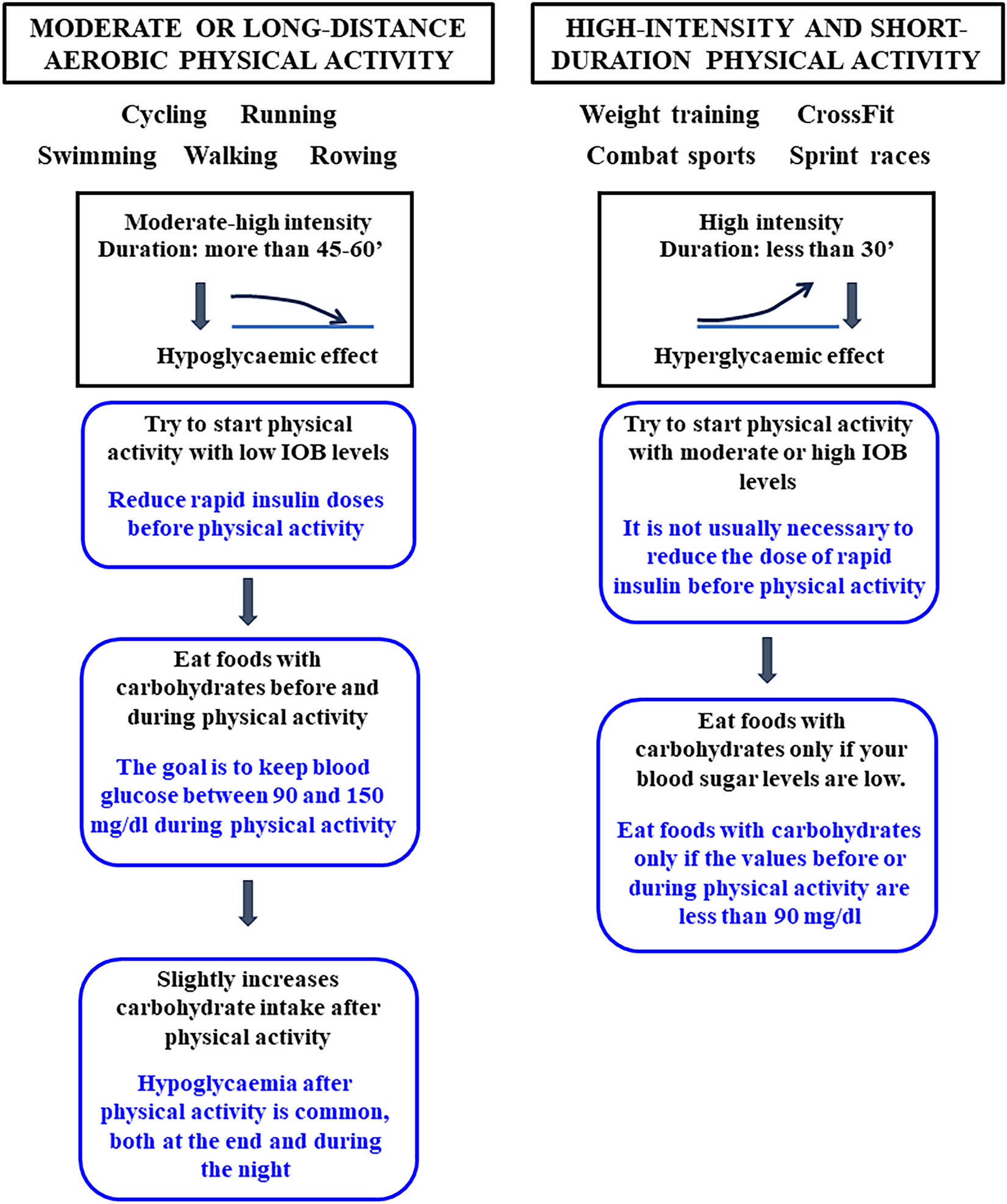
The concept of endurance physical activity covers those activities that are predominantly aerobic, such as running, swimming or cycling, and are performed at moderate/high intensity during long periods of time. In these cases, starting activity in hyperglycaemia is not required. It is important to remark that insulin on board should be reduced. For this purpose, the amount of basal insulin should be lower if physical activity was planned for early morning. In those cases where physical activity was arranged to start after a meal, the amount of rapid insulin to be administered as bolus should also be lower. In those cases where the risk of hypoglycaemia is high according to previous experiences, starting once the activity of rapid insulin has entered the downward phase, that is, roughly 3 h after bolus administration, is recommended.
When glucose levels are roughly 150 mg/dL or lower, carbohydrate intake before initiating physical activity should be considered. During physical activity, carbohydrate intake should be decided according to regularly monitored values. If long duration is planned, for instance long-distance cycling or running, reduction of basal insulin dose may be considered (Fig. 1) [29, 37, 38].
Fig. 1
Recommendations for people with T1D to engage in physical activity safely. IOB insulin on board, T1D type 1 diabetes
The concept of HIIT, also called resistance training, refers to an explosive, interval exercise which is performed at high intensity during short periods of time. A short previous session of aerobic work is recommended to balance the hyperglycaemic effect of the planned activity (never the other way around). Starting anaerobic physical activity with rapid insulin to avoid glucose release by the liver may also be advisable (Fig. 1) [29, 37]. Indeed, it must be remarked that carbohydrate supplements should not be used.
Dietary HabitsAlthough most people with T1D are aware of the meaningful influence of diet on GV, a concerning lack of knowledge regarding specific dietary habits to follow or to avoid to prevent glycaemic excursions can be observed in day-to-day practice.
Appropriate Balance of Nutrients in Each MealIn the classical diet scenario in DM, a meal is supposed to consist of two constituents: carbohydrates and ‘everything else’, namely proteins, fibre and fat. However, the first concept to teach is that carbohydrates, although indeed playing a key role in daily glycaemic levels, are not the only elements influencing these. A correct nutrient balance is achieved when vegetables, wholegrain cereals, extra amount of fibre, lean protein and healthy fat are added to the daily carbohydrate portion. This practice will produce benefits, among which stabilisation of glucose levels after meals will be the main one: the classically observed increase in glucose levels will be delayed and peaks will be lower in intensity. Thus, GV will be lower, and interestingly, the feeling of satiety will increase [39].
Once people with T1D have been educated to acknowledge the importance of all dietary constituents, a series of specific guidelines can be proposed to optimise each meal balance.
Consuming not very different amounts of carbohydrates of similar origin in each meal may help in insulin dose calculation. However, this practice is not mandatory. In fact, it has been shown that appropriate training in insulin dose adjustment facilitates some dietary freedom. Thus, people with T1D should be educated to match insulin doses to their food choices. For this purpose, they should be familiar with the ratio between a given amount of carbohydrates and insulin dose [40].
Reference guides agree in considering the counting of carbohydrates to be a necessary strategy to achieve a good control of GV [41, 42]. To improve glucose response, people with T1D should be encouraged to follow nutritional advice to achieve a controlled intake of carbohydrates. An excessive amount of carbohydrates may be prejudicial to control [43], but too few carbohydrates are not recommended either. Eating a consistent amount of carbohydrates makes insulin dosing easier, although this practice may result in monotonous diet patterns and is difficult to accomplish in everyday life situations such as parties or travel [44]. Requirements may change according to individual hallmarks and the individual glycaemic management target. Importantly, a recent study found a direct association between the amount of carbohydrates per meal and GV in the following 3 h [43]. Indeed, carbohydrate intake influences the level of post-prandial plasma glucose, which in turn contributes to GV and influences glucose excursions [44]. This does not necessarily mean that carbohydrates have to be strictly avoided, since there is no agreement regarding suitability of diets based on very low carbohydrate intake [41].
Carbohydrates have to come from complex sources and fibre. Suitable foods to reduce excessive post-prandial glucose excursions are starch-free vegetables (broccoli, spinach, kale), carbohydrate-low fruit (strawberry, cranberry, avocado) and wholemeal products (oatmeal, quinoa, brown rice). The intake of refined sugars, sweets, candy, cakes, soft drinks and sugar-rich or ultra-processed foods has to be avoided or strictly limited.
People with T1D have to be educated to learn the glycaemic index of each food type, or at least the range within which each value is located. The glycaemic index ranks foods according to their effect on blood glucose level. As a general rule, foods with low glycaemic index should be preferred, since the increase in circulating glucose level that is achieved subsequent to their intake is more gradual and controlled. Table 3 stratifies foods according to glycaemic index. In any case, it is important to consider that this variable provides rather relative information, since the value is contingent upon food combination and the way food is cooked. Furthermore, glycaemic index calculations have been generally performed in people with no T1D. In any case, the glycaemic index is useful to decide the right moment to administer pre-prandial insulin. As a general rule, high glycaemic index foods will require longer delays between insulin injection and food intake. More information regarding this topic may be found elsewhere [45,46,47].
Table 3 Foods stratified according to glycaemic indexHigh-fat and high-protein meals also increase insulin requirement. Several studies demonstrated that, despite identical carbohydrate contents, high-fat and high-protein meals may enhance insulin demand [48,49,50]. Furthermore, their effect is additive [51]. A dose–response relationship between the amount of fat, regardless of the type, and post-prandial glycaemia, has been reported. Mealtime insulin doses may need to be increased by up to 20% for 60 g fat meals. Moreover, dual wave dosing may be required for optimisation of glycaemic responses. In these cases, the amount of insulin in the first and second injections, and the time between these, are highly dependent on the total amount of fat [52]. Further, a high-protein diet has been described to exert a positive effect on glycaemic management in people with T1D, who exhibit lower glycaemic variability and spend a shorter time in hypoglycaemia [53]. It must be remarked that high-protein diet (daily intake ≥ 1.2 g/kg/day) has been associated with improved glycaemic management after physical activity in adolescents with T1D [54].
Meal Schedule and FrequencyAlthough meal schedule may vary for people with T1D according to individual requirement and/or preferences, there are a few useful general guidelines that may be proposed.
Carbohydrate intake has to be balanced throughout all daily meals instead of being concentrated in only one main meal.
There must be a proper coordination between meals and physical activity. As a general rule, it is better to plan the larger meals for the first part of the day. Carbohydrate intake in the evening/night should be lower, as physical activity usually decreases at that time. Before starting any kind of physical activity, the glucose level has to be monitored. Intake of carbohydrate, which is recommended before endurance physical activity starts, will be dependent upon baseline glucose value. If this is suitable, the carbohydrate intake has to be lower than that to be consumed in the event that glucose circulating levels are under the desired range (Fig. 1).
People with T1D must be aware of the importance of closely following the proposed guidelines regarding close coordination between meal schedule and insulin dosing [55].
Sequential Nutrient IntakeSequential nutrient intake is a strategy aimed to reduce meal-induced glycaemic variation. The rule is simple: to prevent glucose peaks subsequent to meals, vegetables, proteins and fat should be ingested earlier than starchy foods or fruits [56]. By doing this, gastric emptying is delayed, which allows for a more gradual passage of carbohydrates to blood [57].
Food Cooking/ProcessingCooking times should be short, since lightly cooked foods will pass more slowly to the bloodstream. Solid foods should be chosen before liquid ones. It is important to note that keeping starchy foods for a long time (≥ 24 h) at low temperatures impairs starch absorption and thus results in reduced glycaemic responses, which may increase the risk of hypoglycaemia [58]. Vinegar and fermented or organic acid-rich foods have also been suggested to reduce glycaemic response, although their mechanism of action is not totally understood [59, 60].
Insulin TherapyInsulin pumps, particularly in combination with glucose sensors in advanced hybrid closed loop (AHCL) systems, have undoubtedly demonstrated better glycaemic management as compared with multiple daily injections (MDI) by reducing glycaemic excursions and promoting sustained improvement of TIR, Glycaemia Risk Index (GRI) and other CGM metrics [61,62,63,64,65], reviewed in 66. However, this technology is not available to many people with T1D yet. AHCL systems require user training for adequate mealtime bolusing, pump set changes, CGM device insertion and other actions. Limited access, higher costs and lack of trained staff also represent barriers for the widespread use of AHCL systems [67, 68]. Therefore, for the time being, MDI-based regimens will remain the cornerstone for the treatment of many people with T1D in the forthcoming years, and thus guidelines to reduce GV when using MDI therapies are needed. The following recommendations are focused on this population.
A correct use of basal insulin is mandatory to reduce the risk of glycaemic excursions, particularly at night-time and in-between the meals. The type of long-acting insulin might have an influence on GV. Glycaemic variability is lower in magnitude with second-generation basal insulins (glargine U300, degludec) that have a longer duration and a more protracted and sustained insulin profile than with first-generation basal insulins (glargine U100, detemir). However, despite these advantages, second-generation basal insulins have not demonstrated a clear superiority in terms of HbA1c reduction as compared with the first-generation basal insulins [69,70,71].
Physicians have to personalise insulin regimen according to individual characteristics and needs of people with T1D, adjusting type of insulin regime, insulin doses and number of injections when required. People with T1D need to receive appropriate diabetes education, particularly to avoid missed or mistimed insulin doses that are some of the main causes of high GV [72].
Missing Insulin InjectionsMissing insulin doses or mistimed insulin administration are not uncommon in people with T1D. People with T1D using CGM systems may manually take note of time and amount of each insulin administration. For those using connected pens or caps (described below) registration of time and dosing is automated.
When first-generation basal insulins are being used, it is recommended to administer them at the same time of the day. However, the second generation basal insulin allows for a wider time window for insulin dosing. Glargine U300 and degludec may be administered within a time window of 4 h and up to at least 8 h or more, respectively [73, 74].
People with T1D need to know what they should do if they skip doses or administer insulin later than expected. In any case, action(s) to correct this situation should not be delayed. People with T1D should check glucose level and proceed according to their hypoglycaemia risk. If this is low, correcting doses of short-acting insulin may be used with glucose levels in the range of grade 1 hyperglycaemia or higher (> 180 mg/dL). People with T1D with a high risk of hypoglycaemia should not use rapid-acting insulin unless they present with glucose levels indicating at least grade 2 hyperglycaemia (> 250 mg/dL). It must be noted that individual insulin sensitivity factor (ISF), which indicates the estimated amount of glucose concentration that is reduced by 1 unit of rapid-acting insulin, should be used to assess appropriate correcting doses. Thereafter, the usual basal insulin dosing scheme should be resumed. It is important to educate people with T1D to avoid the injection of a double dose to compensate for the forgotten one.
In this context, rapid-acting and ultra-rapid short-acting insulin analogues present an advantage over their long-acting insulin analogues, since their correcting effect occurs earlier on. When people with T1D realise the omission in the following 2 h after the scheduled dosage time, rapid-acting insulin should be injected at the usual dose as soon as possible. When the omission is noted later than 2 h after the scheduled dosage time, rapid-acting insulin should be injected promptly. However, people with T1D may have to reduce and recalculate the dose if a new meal is close. In both situations, blood glucose levels should be closely monitored in the following hours.
If omissions have been repeated for several times in a short period of time, reporting to the health team is recommended.
Mistimed Dosing of Rapid-Acting Insulin in Relation to MealsFrom CGM registries, we know now that rapid and ultra-rapid insulin should be administered 15–20 or 5–10 min before mealtime, respectively. If it is injected later, either during or shortly after the meal, post-prandial hyperglycaemia is the consequence, or there is also an increased risk of late hypoglycaemia. This recommendation is particularly relevant when eating high or moderate glycaemic index foods [55], while it may be unnecessary when eating low glycaemic foods.
Light Meals without Prior Insulin DosingPeople with T1D have to be aware of the major impact on glycaemic management exerted by even light meals with few carbohydrate content taken as snacks at mid-morning, mid-evening and so on, if insulin is not administered. The contribution of snacks to total dietary intake has been recently acknowledged, and the association of their intake with hyperglycaemia risk is stronger with MDI using connected pens or caps as compared with AHCL systems [75].
Improper Adjusting of Insulin DoseIt is important to empower people with T1D to know and use the ISF. This is estimated by dividing 1800 by the total (basal and mealtime insulins) daily dose of insulin (TDD). ISF, which is expressed in mg/dL, is useful for people with T1D to adjust the dose of rapid insulin required before each meal according to pre-meal measured and post-meal target glucose values. The adjusted dose calculated according to ISF value is added to, or subtracted from, the planned dose to cover the amount of carbohydrates of each meal [76]. Table 4 presents adjustment recommendations according to glucose level, trend and ISF in adults and children [77]. When using CGM, trend arrows such as those included in this table provide valuable information for making insulin dosing decisions, especially around mealtimes, and for preventing hypoglycaemia. While trend arrows enhance diabetes management by offering real-time feedback on glucose dynamics, their interpretation requires careful consideration and may vary among individuals, and collaborative efforts between people with T1D and healthcare providers are thus essential for optimising insulin dosing strategies on the basis of these tools.
Table 4 Recommendations to adjust prandial insulin dose in adults and children using FreeStyle Libre-based systemsCorrecting Insulin Dosing between Main MealsIn the event that the time between main meals is rather long, glucose monitoring is recommended. Corrective doses should be generally avoided unless a major error in previous carbohydrates estimation is noticed or where high glucose levels, roughly > 250 mg/dL, are detected. In these cases, insulin bolus calculators, either as mobile phone apps or integrated in connected devices or insulin pumps, may be useful for a more precise correction of hyperglycaemia, since they consider the amount of circulating active insulin. Indeed, calculations should also consider ISF [78].
Insufficient Rotation of Insulin Injection SitesFor insulin injection, a rotation around the same injection area is recommended to avoid lipodystrophies that would result in uneven insulin absorption and therefore unforeseen effects [79, 80]. By contrast, frequent change of injection areas may introduce undesired variability regarding insulin effect [81].
Connected Pens and Caps May Help to Improve Therapeutic ManagementConnected pens and caps were developed to register time and dose of insulin administration. In addition, their connection with CGM systems make it possible to track dosing information with glucose profiles [82]. Use of these devices has resulted in reduced dose omissions and improved glycaemic management, higher adherence to appropriate insulin administration and more treatment satisfaction [83]. These devices are particularly useful in those situations where dose omissions may more easily occur such as with adolescents and some young adults. A minimum training by the DNE or other members of the healthcare team is usually necessary. Nevertheless, challenges for widespread implementation of connected pens remain, and barriers have been identified, namely economic burden, need for advanced educational support, minimum digital knowledge, availability of compatible mobile phones or need for updated maintenance of applications [82].
Other Causes of GV IncreaseThe requirement for non-stop control of glycaemic blood level, the continuous need for insulin therapy or the permanent requirement to control physical activity and dietary habits can lead people with T1D to emotional distress, which has been associated with GV [84]. There are some behaviours that may help to preserve a stable, positive mood and thus minimise the risk of distress. Firstly, people with T1D should maintain a close relationship with physicians, DNEs and nutritionists. The former should provide people with T1D with information and support to control the disease appropriately. Secondly, these should be encouraged to regularly monitor glucose values, learn to recognise those factors influencing control and know/apply those measures required to keep circulating glucose levels within the desired range. By doing this, their empowerment regarding their disease grows, with the subsequent decrease in distress. Furthermore, people with T1D should seek emotional support from relatives, friends and support groups, and learn skills such as deep breathing, meditation or yoga to feel a sense of calm and wellbeing. People with T1D should also devote daily time to their favourite activities, enabling enjoyment and relaxation. Finally, developing healthy sleeping habits is highly advisable: a direct association between inappropriate sleep quality, categorised as good or poor according to a composite variable consisting of sleep efficiency, wake after sleep onset and number of awakenings, has been associated with overnight GV [85].
Comments (0)