
Remember me
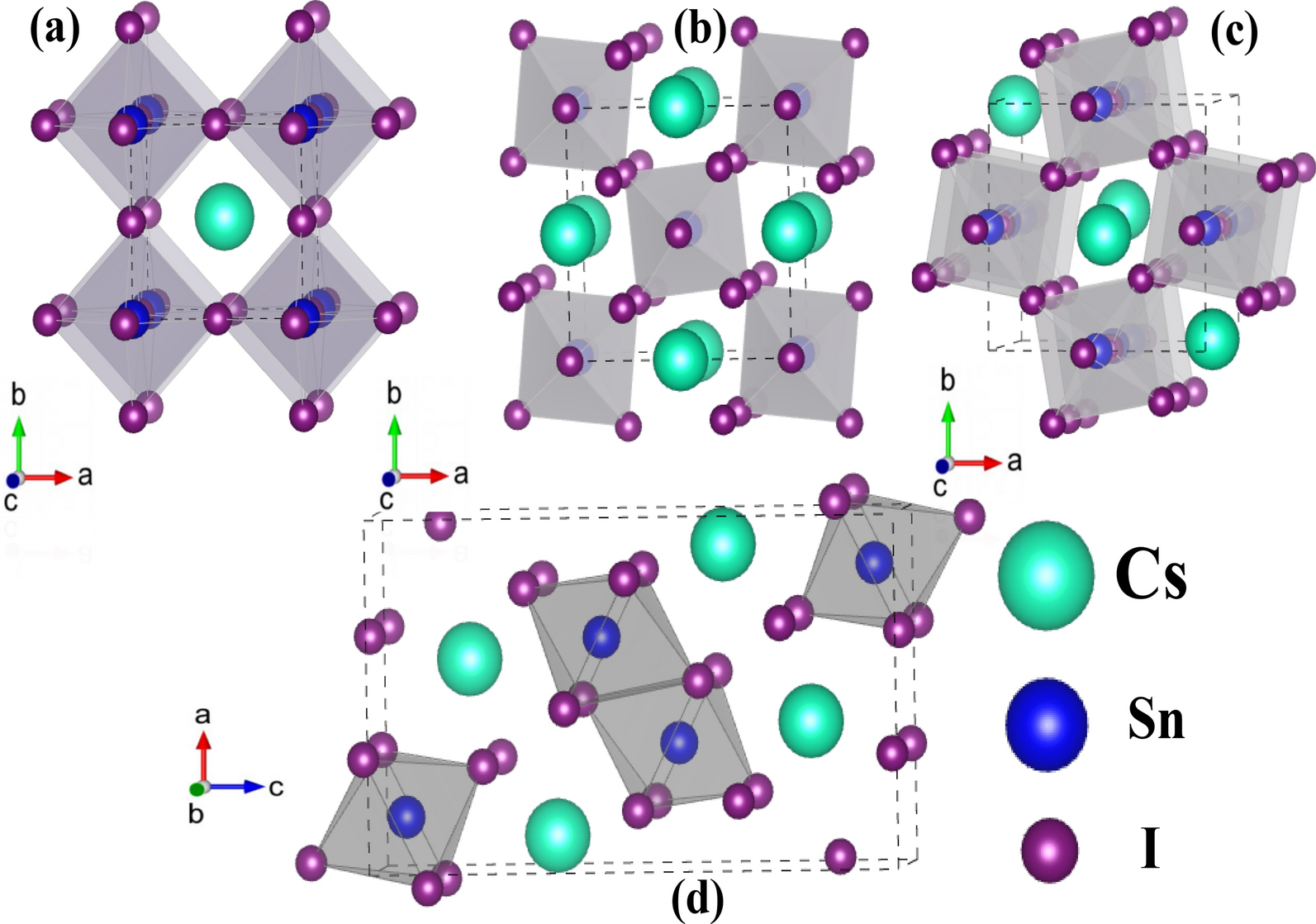

The calculated structural parameters, lattice constants, Sn–I bond lengths, and Sn–I–Sn bond angles of the α-, β-, γ-, and δ-phases of CsSnI3 by GGA-PBE and SCAN functionals are summarized in Table I with the experimental values. Comparison between calculated and experimental structural parameters shows that the SCAN functional reproduces the geometric structure of the systems better than the GGA-PBE functional. The geometric parameters calculated by SCAN are in good agreement with the experimental ones, which indicates the effectiveness of the use of SCAN for the relaxation of these solid-state halide materials. The results are also compared with earlier calculations by da Silva et al.38 with a higher energy cutoff value (800 eV). The current results are close to those of the earlier theoretical study.39 However, comparing with experimental results, it can be seen that SCAN is the most accurate for describing the geometry of this material.40,41,42,43 According to the calculations, interatomic distances, especially Sn–I, change significantly depending on the phase formation of CsSnI3. Along with this, the bond angles Sn–I1–Sn and Sn–I2–Sn also change. The relaxed crystal structures of the four phases are shown in Fig. 1. Based on the obtained relaxed equilibrium geometric structures (Table II), the total energies of the α-, β-, γ-, and δ-phases of CsSnI3 are calculated using the GGA functional, which show that the most stable conformation for CsSnI3 is the δ-modification of this compound. According to the results, the energetic order of CsSnI3 polymorphs is Eβ > Eα > Eγ > Eδ. The energy difference of the phases with respect to the δ-phase are indicated as ΔE, which confirmed that γ-CsSnI3 is the most stable among triiodides with perovskite structure (Table II). Also, from the calculated phonon dispersion diagram shown in Fig. 2, we can see that δ-CsSnI3 has no imaginary part of the frequencies, which indicates that the δ-phase of CsSnI3 is dynamically stable. On the other hand, other phases show phonon bands with imaginary frequency, which imply that these phases have dynamical instability at certain directions defined by the k-point in the figures.
Table I Relaxed lattice parameters of α-, β-, γ-, and δ- modifications of CsSnI3; the calculated results are compared with the experimental resultsFig. 1
Schematic illustration of optimized crystal lattices of four modifications of CsSnI3: (a) cubic (α-phase), (b) tetragonal (β-phase), (c) orthorhombic (γ-phase), and (d) non-perovskite orthorhombic (δ-phase).
Table II Calculated total electronic energies of different phases of CsSnI3 by GGA-PBEFig. 2
Calculated phonon dispersion diagram of (a) α-CsSnI3, (b) β-CsSnI3, (c) γ-CsSnI3, and (d) δ-CsSnI3.
According to the results given in Table II, the CsSnI3 compound stabilizes as its transitions from the cubic phase to the orthorhombic phase or to a non-perovskite structure. According to the results, when we consider the cubic to the orthorhombic phase, the total energy decreases, which indicates the relative stability of the orthorhombic phase of the perovskite in environmental conditions.
We further investigated the electronic and optical properties of α-, β-, γ-, and δ-phases of CsSnI3 to study the effect of phase changes on the electronic properties, such as band states, Fermi level shift, absorption, and reflectance of these compounds, since deciphering the characterization is crucial in terms of the use of the material in optoelectronic devices.44,45,46,47,48,49
We performed calculations to obtain the band gap for the well-optimized structures by SCAN of the α-, β-, γ-, and δ-phases of CsSnI3 using the GGA, SCAN, and hybrid (HSE06) functionals, which are compared with the experimental values in Table III. According to Table III, different potentials estimate the band gap differently. In particular, SCAN and GGA-PBE showed a fairly small band gap compared to HSE06, which is an expensive approach giving results comparable to experiments. In contrast to the results reported by Wang et al.,31 the results obtained with HSE06 are slightly closer to the experimental data. In particular, HSE06 gives good results that are comparable to the experiment for α-CsSnI3 and δ-CsSnI339,50 in comparison with earlier studies with GGA-PBE and GGA-PBEsol functionals.39,52,53 On the other hand, for γ-CsSnI3 the band gap value is slightly higher than the ones in the earlier literature, including its experimental value,51 and the result obtained here was similar to this experiment using Tran–Blaha-modified Becke–Johnson (TB-mBJ) calculations.54 However, in principle, the HSE06 results turned out to be more accurate than the results of previous theoretical results, where the main focus was on the application of LDA, GGA-PBE, and GGA-PBEsol.39,52,53,54 However, the band gap underestimations are within the range of typical error in calculations using these conventional functionals.55 Thus, despite the lengthy costs in HSE06 calculations, it was proved that the HSE06 can reproduce the band gap quantitatively, Fig. 3 shows the dependence of the band gap width of CsSnI3 on the phase of existence.
Table III Calculated and experimental band gaps of α-, β-, γ-, and δ-phase CsSnI3 in eVFig. 3
Diagram of dependence of the value of the band gap calculated using different xc-functionals on the phase of CsSnI3 polymorphs
As can be seen from Fig. 3, the band gap of CsSnI3 decreases when the yellow non-perovskite phase (δ-phase) transitions to the black cubic phase (α-phase), and then begins to increase during the next phase transformation from β- to γ-phase. Similar trends in changes in the band gap caused by changes in the volume of CsSnI3 under the influence of their phase transitions are shown by the calculations within all the frameworks of GGA, SCAN, and HSE06.
For more detailed understandings of these phenomena, we assessed the Fermi level shift as a consequence of the phase transitions of CsSnI3 as shown in Fig. 4 These shifts are assessed by determining the change in the energy position of the highest electrons in the valence band for each phase. In this case, the maximum of the valence band of γ-CsSnI3 was taken as the starting point for comparative analysis. According to Fig. 4, during the yellow–black phase transition of CsSnI3, the Fermi level drops to the region with a negative energy value, i.e., towards the valence band (VB), and the band gap decreases from 2.99 eV to 1.33 eV. During the transition from α- to β-phases, the band gap decreases further to 1.23 eV and the Fermi level mixes by 1.65 eV towards the conduction band (CB), while during β → γ transitions the band gap increases to 1.44 eV, and once again the Fermi level shifts by 0.41 eV in the direction to the conduction band. The reason for this phenomenon is that in semiconductors, the Fermi level depends on temperature and occupancy of energy levels in the VB and CB of polymorphs CsSnI3. In the process of phase transformation as a consequence of temperature increase, free electrons and holes are formed (thermal fluctuations delocalize these states and the density of free carriers increases), leading to a corresponding shift of the Fermi level in CsSnI3. Therefore, it is reported that highly correlated and disordered systems can show Fermi level growth because they have many local states.56 The calculated energy band distribution diagrams showed that all three perovskite modifications of CsSnI3 have direct transitions (Fig. 5a, b, and c), and δ-CsSnI3 has an indirect transition (Fig. 5d). That is, despite the low structural stability, all three perovskite phases of CsSnI3 are semiconductors with direct transitions, which is important from the point of view of their application in photovoltaics and laser technology.57,58
Fig. 4
Diagram of the calculated band gaps and Fermi levels α-, β-, γ-, and δ-phases of CsSnI3.
Fig. 5
GGA-calculated band structure diagram for (a) α-CsSnI3, (b) β-CsSnI3, (c) γ- CsSnI3, and (d) δ-CsSnI3.
Figure 6a shows the total densities of electronic states of the α-, β-, γ-, and δ-phases of CsSnI3, from which it can be seen that α-CsSnI3 is characterized by moderate densities of state in the vicinity of the valence band. However, as CsSnI3 moves to lower temperature phases, the density of state increases at the threshold where the VB and CB meet. The projected density of states (PDOSs) diagram shown in Fig. 6b shows that the formation of the CB of CsSnI3 is mainly contributed by the s- and p-states. A moderate clade of d-orbitals is also noticeable in all phases. It can be seen that the contribution of p-states increases sharply with the transition from the cubic perovskite conformation (α-phase) to its non-perovskite δ-phase.
Fig. 6
Comparison of (a) total electronic density of states and (b) diagram of the contributions of the s-, p-, and d-components of the α-, β-, γ-, and δ-phases of CsSnI3 in the conduction band. The top of the VB is scaled to zero.
Next, using well-optimized crystal lattices with SCAN, we calculated the optical properties of the investigated materials. Optical phenomena including absorption, reflection, and transmission are present in all types of materials and can be studied at both the microscopic and macroscopic level. In bulk materials, the complex permittivity is closely related to the band structure at the microscopic or quantum mechanical level.59 Optical properties such as the refractive index and absorption coefficient indicate the response of the material when photons hit them. The real part of the permittivity, which is considered an inherent property of any material, indicates the stored energy that can be released at zero energy or frequency limit. Using the Ab initio calculation algorithms implemented in the VASP code, the complex imaginary permittivity (ε2) can be obtained in the PAW method by summation over conduction bands, where the expression obtained in Ref. 60 for determining ε2(ω) has the following form:
$$\varepsilon_^ \left( \omega \right) = \frac e^ }}\frac }}\mathop \limits_ \mathop \sum \limits_ 2\omega_ \delta \left( - \smallint_ - \omega } \right) \times u_ q}} |u_ u_ q}} |u_^$$
(1)
In the above equation, the transitions are made from occupied to unoccupied states within the first Brillouin zone, and the wave vectors are fixed k. Real (ε1) and imaginary (ε2) parts of the analytical dielectric function are connected by the Kramers–Kronig relations,61
$$\varepsilon_^ \left( \omega \right) = 1 + \fracP\mathop \smallint \limits_^ \mathop \limits_ \frac^ \left( } \right)\omega^ }} - \omega^ + in}} }\omega^$$
(2)
Given Eqs. 1–2, the optical conductivity spectrum (σ), energy loss spectrum (L), refractive index (n), reflection coefficient (R), absorption coefficient (α), and extinction coefficient (k) may be calculated as follows:
$$R\left( \omega \right) = \left| - 1}} + 1}}} \right|^$$
(3)
where \(\varepsilon \left( \omega \right) = \varepsilon_ \left( \omega \right) + i\varepsilon_ \left( \omega \right)\).
$$L\left( \omega \right) = \frac \left( \omega \right)}}^ \left( \omega \right) + \varepsilon_^ \left( \omega \right)}}$$
(4)
$$n\left( \omega \right) = \left| ^ + \varepsilon_^ } + \varepsilon_ }}} \right|^}$$
(5)
$$k\left( \omega \right) = \left| ^ + \varepsilon_^ } - \varepsilon_ }}} \right|^}$$
(6)
$$\alpha \left( \omega \right) = \frac = \frac \left( \omega \right)\omega }}$$
(7)
$$\sigma \left( \omega \right) = \sigma_ \left( \omega \right) + i\sigma_ \left( \omega \right) = - i\frac\left[ \right] = \frac \left( \omega \right)\omega }} + i\frac \left( \omega \right)\omega }}$$
(8)
Figures 7, 8, and 9 summarize the calculated results of the optical properties of α-, β-, γ-, and δ-phases of CsSnI3, from which it can be seen that the behavior of the spectra of optical absorption (α), photoconductivity (σ), and energy loss function (L) obey the trend of changes in the band gap due to volume vibration as a result of CsSnI3 transitions.
Fig. 7
Calculated absorption coefficient α-, β-, γ-, and δ-phases of CsSnI3 as a function of photon energy in the X direction.
Fig. 8
Calculated photon energy-dependent energy loss functions α-, β-, γ-, and δ-phases of CsSnI3 in the X direction.
Fig. 9
Calculated optical conductivity of α-, β-, γ-, and δ-phases of CsSnI3 depending on photon energy in the X direction.
From the spectra presented in Figs. 7, 8, and 9, it is clearly seen that the absorption and photoconductivity of the CsSnI3 compound improves in the infrared (IR) and visible range of light radiation as the transition from the low-temperature to the high-temperature phase occurs, and a stable yellow phase of CsSnI3, i.e., δ-phase, absorbs only short-wavelength light rays. High absorption and optical conductivity indicate that all CsSnI3 crystals with a perovskite structure have ideal spectral characteristics that are well suited for photovoltaic applications; however, when entering a more stable phase, CsSnI3 is activated only in the ultraviolet range of electromagnetic waves. By applying the necessary measures to stabilize CsSnI3 without significant changes in the band gap and loss of their absorption capacity, it is possible to obtain unique materials as the main absorbing layers in new generation solar panels. Figure 10 shows the phase dependence of optical constants using the example of static permittivity (ε) and refractive index (n), which are similar to the above results and confirm the relationship between the band gap and phase transitions of CsSnI3.
Fig. 10
Histograms of the dependence of the static dielectric constant (ε) and refractive index (n) on the phase formation of CsSnI3 calculated along the X direction.
The obtained results complement the base of scientific works performed in the field of perovskite compounds for the development of green energy, and can be used by experimentalists in further studies of crystals and thin films based on CsSnI3.
Comments (0)