Cell culture
All glioma cells (U118, ATCC HTB-15; U251 Millipore Sigma, 09063001) were cultured in DMEM-F12 media (15% FBS, 1% penicillin-strep, 1% Na-pyruvate, 1.5% HEPES, 0.1% insulin, and 0.02% fibroblast growth factor) and grown to 70–80% confluence at 21% O2. Patient-derived glioblastoma cells (GBM06/GBM39 are primary GBM cells from a male donor, GBM76 is a recurrent GBM from a male donor) were a gift from Dr. Jann Sarkaria, MD (Mayo Clinic, Rochester, MN). All cells were confirmed to be mycoplasma negative by the University of Iowa Genomics Core before use. Commercial cells were used for up to 15 passages and patient-derived cells were used for up to 10 passages.
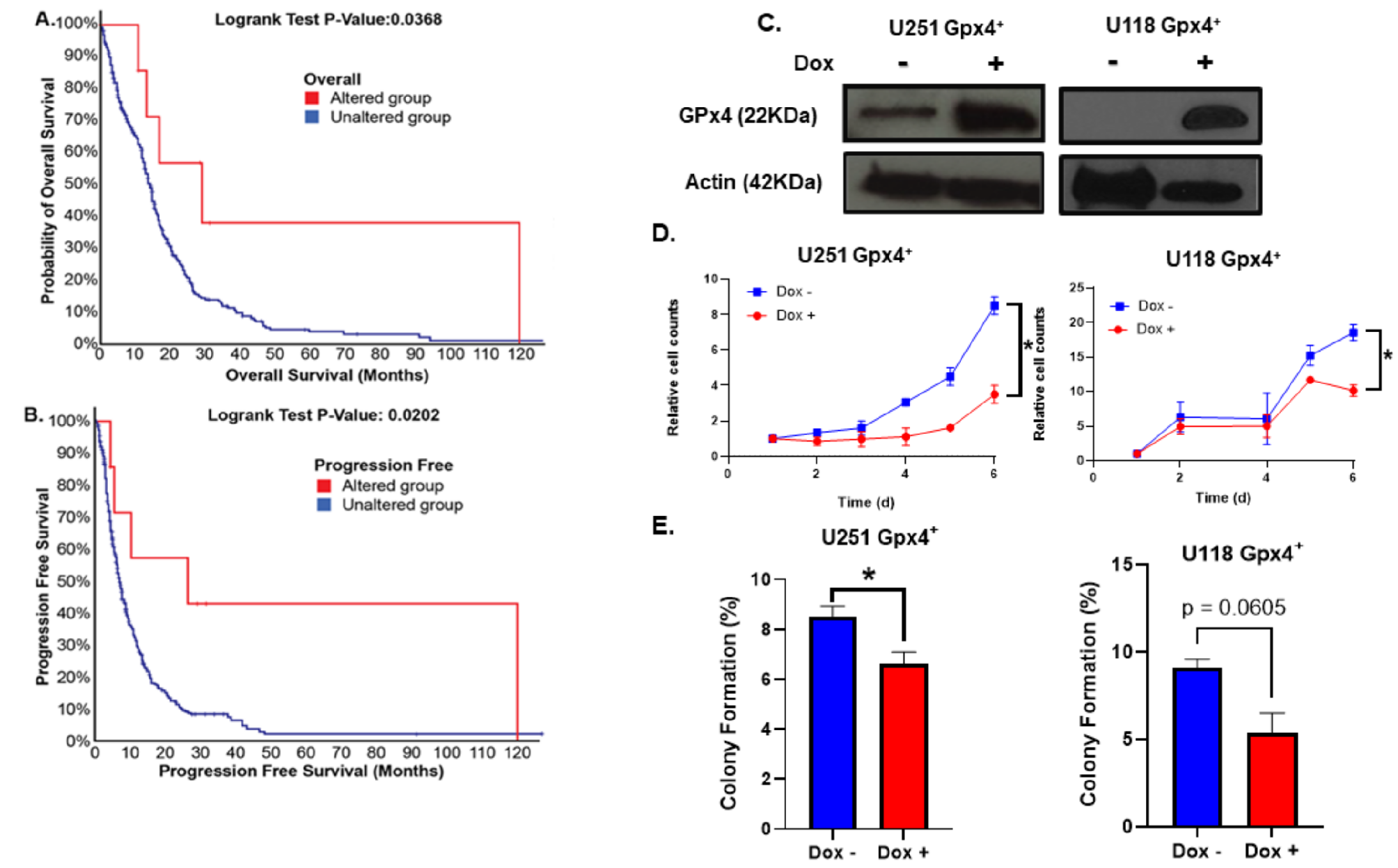
The GPx4+-pTRIPZ vectors were provided by the laboratory of Douglas Spitz and used as previously described [12]. To produce lentivirus, TSA201 cells were used along with VSV-G and psPAX2 helper vectors (Addgene). Virus was collected from TSA201 cell cultures, centrifuged to remove cell debris, and filtered using 0.45 μm filters from the ZymoPUREtm II Plasmid Midiprep Kit (Zymo Research, Irvine CA, USA). Cells were plated and allowed to grow for 24 h, and then virus was added to cells with 8 µg/mL of polybrene for a total of 48 h, with fresh virus being added after 24 h. Following transduction, cells were selected with 2.5 µg/mL puromycin. The general population that survived the puromycin selection where then validated for overexpression by treating them with 1 µg mL− 1 doxycycline hyclate (Fisher Bioreagents BP2653-5, Geel, Belgium) for 48 h. Low density cell suspensions were then grown in to 96 well plate to form single cell clones. Picked clones were also treated with 1 µg mL− 1 doxycycline for 48 h to validate the overexpression.
Atomic force microscopy
Cells were treated for the designated time period, trypsinized, and counted. Cells were then plated as single cells (≈ 8000 cells) on a cover slip in a 60 mm3 dish 24 h prior to analysis. All cell stiffness measurements were performed using a Molecular Force Probe 3D AFM (Asylum Research, Santa Barbara, CA) nanoindentation measurements using AFM tips (Nanotools, Germany, biosphere™ B2000-CONT) with a high-density, diamond-like carbon sphere of radius 2 μm attached at the end of a flexible cantilever with a spring constant of 0.2 N/m. Single cells were located using an AFM optical camera before the nanoindentation measurements. Nanoindentation measurements involved collecting force–vertical displacement curves in contact mode in a phosphate-buffered saline buffer at 22 ± 2 °C at an approximate center of each cell with a maximum applied loading force of 3 nN and a 500 nm/s approach velocity. At least three repeated force-vertical displacement measurements were collected per each cell and typically ten individual cells were measured per each sample. The force-vertical displacement profiles were converted to force-indentation distance and the approach to the surface data was fit using the Hertzian elastic contact model to calculate the corresponding cell stiffness (Young’s modulus) as described previously [13]. For the model, the AFM tip was modeled as a sphere with a radius of 2 μm, and Poisson ratios of the tip and cell were assumed to be 0.2 and 0.25, respectively. For each cell, fitted Young’s modulus results based on at least three repeated measurements were averaged to yield an average cell stiffness value.
Cell growth
To evaluate cell growth rates, 100,000 cells for each group was plated on day 0. Cells were treated daily with 1 µg mL− 1 doxycycline in fresh media (total load of 6 µg mL− 1 doxycycline over 6 days) and counted to evaluate cell growth. Cells were harvested with trypsin and the total attached cell population was counted using a Beckman Coulter counter. The number of cells at each time point were normalized to the control time point (100,000) to evaluate relative growth.
Colony formation
Cells were treated, washed, and trypsinized. Following trypsinization, cells were counted and plated as single cells in a 6-well dish (≈ 500–1000 cells per well). Cells were left undisturbed for 7–10 days to allow for colony formation. Colonies were then washed with 70% EtOH for fixation and stained with Coomassie blue. Stained colonies (≥ 50 cells) were counted under a microscope.
Cell migration
Following 24–48 h of incubation, 600,000 cells were plated in the top well of a trans-well chamber (8 μm pore size) in 500 ul of 1% FBS. The trans-well chamber was suspended in 1 ml of DMEM/F12 BR15 media in a 24-well dish for 24 h. Following incubation the media was removed from the top of the trans-well and the remaining cells on top of the membrane were removed using a cotton swab. Next, the trans-well chamber was removed from the 6-well plate and the migrating cells on the bottom of the membrane were stained by placing the trans-well chamber into 1 mL (concentration = 0.5 mg/mL) of a Thiazolyl Blue Tetrazolium Bromide (MTT) solution for 1-hour. Following incubation in MTT, the stained trans-well chamber membrane was incubated at 37 °C for 20 min in 300 µL of DMSO. Finally, the stained DMSO solution was transferred to a 96-well plate, and the absorption at 550 nm was measured using a plate reader to evaluate the migrating cells. The absorbance of the treated cells was normalized to the control cells to approximate the relative cell migration.
Cell cycle analysis
Prior to cell cycle analysis, cells were trypsinized, centrifuged, and the pellets were fixed in 70% EtOH and stored at 4 °C. The fixed cells were stained with 1 µg mL − 1 propidium iodide (PI) (catalog #P4170-25MG, Sigma-Aldrich) and the cell cycle distribution was analyzed with a UV-LSR flow cytometer, by measuring the red fluorescence of the PI-stained DNA content. Cell cycle distribution (%) based on DNA content was calculated using FlowJo V10 software.
Live cell tracking
Cells were treated for the designated time period, trypsinized, and counted. Cells were then plated as single cells (≈ 8000 cells) in a glass-bottom 6-well plate 24 h prior to analysis. Prior to analysis cells were stained for 3 h with NucSpot® 488 Live Cell stain per manufacturer’s instructions (Biotium #40081, Freemont, CA). Live cells were imaged with a Zeiss LSM 980 AiryScan2 confocal microscope temporally in 15-minute intervals to evaluate cell motility. Image analysis was performed using Oxford Imaris to calculate mean squared displacement.
Western blotting
Cells were lysed in 1X RIPA (Sigma-Aldrich) and total protein was quantified using DC™ protein assay kit (Bio-Rad). 20 µg of total protein from cell lysates was used for western blotting. Electrophoresis was carried out at 100 V on a 4–20% pre-cast gradient gel (Bio-Rad) for 60 min. PVDF membrane (Bio-Rad) was used to transfer proteins at 4° C, 100 V for 60 min. Following transfer, the membrane was blocked using 5% non-fat dry milk in 0.2% PBS-Tween (PBST) for 2 h at room temperature. At 4 °C, primary antibody incubation was done overnight. Gpx4+ (1:1000, Abcam) and β-actin (1:1000, Cell Signaling) primary antibodies were used. The membrane was then washed 3 times for 10 min with PBST and incubated with horseradish peroxidase-conjugated anti-mouse secondary antibody (1:10,000–1:20,000; Cell Signaling) for 1 h at room temperature. Following 3 × 10-minute PBST washes, a chemiluminescent kit (Super Signal West Pico & Super Signal West Femto, Thermo Scientific) was added to the membrane and exposed on an X-ray film (Research Products International).






Comments (0)