
Remember me


To investigate transcriptomic changes in the WAT endothelium during precachexia, we used the KPC pancreatic adenocarcinoma (PDAC) cachexia mouse model (Fig. 1a). Subcutaneous WAT (sWAT) fat pads were excised at a time point when no differences in body weight and WAT mass compared to age-matched non-tumor-bearing mice were yet observed (Fig. 1b). RNA profiles from isolated AT-ECs at this precachectic state were compared by microarray analysis. Ingenuity Pathway Analysis (IPA) predicted Notch1 as a top upstream regulator of transcriptomic changes in KPC AT-ECs (Fig. 1c). Notch1, a master regulator of angiogenesis and angiocrine signaling13, is frequently overactivated in tumor ECs and in ECs within the premetastatic niche11,14. Quantitative PCR with reverse transcription (RT–qPCR) confirmed upregulation of prototypical Notch1 target genes (Fig. 1d) and the gene encoding the Notch ligand JAG1 in AT-ECs (Extended Data. Fig. 1a) but not in muscle ECs (Extended Data Fig. 1b,c). Elevated Hey2, Jag1 and Notch1 expression was also observed in whole sWAT fat pads during cachexia in C26 colorectal tumor-bearing mice (Extended Data Fig. 1d–f), showing that this genetic program is not restricted to PDAC. Coimmunostainings of the nuclear EC marker ERG and nuclear Notch1 in sWAT from KPC mice further validated increased active Notch1 signaling in AT-ECs (Fig. 1e,f).
Fig. 1: Tumors induce Notch1 overactivation in the adipose tissue endothelium.
a, Timeline of AT-EC isolation from precachectic mice injected intraperitoneally (i.p.) with KPC pancreatic adenocarcinoma cells. b, Relative mass of sWAT collected from KPC precachectic mice (n = 6 animals per group). c, Top ten IPA-predicted upstream regulators of transcriptomic changes in sWAT AT-ECs from precachectic versus non-tumor-bearing mice. Plotted are z scores and –log10 (P values); n = 3–4. d, mRNA levels of prototypical Notch target genes and signaling components in precachectic AT-ECs (n = 6 animals per group). e, Representative images of ERG (DAB, brown) and Notch1 (AP, red) co-stainings comparing sWAT from PBS-injected (control) and KPC-injected mice; scale bar, 50 µm. f, Quantification of ERG+Notch1+ ECs in sWAT (n = 6 animals per group, ten images averaged per mouse); AU, arbitrary units. g, Enrichment of an ‘AT-EC Notch1 gene signature’ was analyzed in publicly available datasets from whole vWAT biopsies from healthy individuals and individuals with precachexia and cachexia (GSE131835). h, Enrichment plots of the ‘AT-EC Notch1 gene signature’ comparing precachectic and cachectic vWAT to healthy vWAT; NES, normalized enrichment score; FDR, false discovery rate. Data shown represent mean ± s.e.m. Data were analyzed by unpaired, two-sided t-test with Welch correction. Experiments in b and d were performed twice with consistent results. Results shown are from one representative experiment.
Next, we assessed whether cancer cachexia in humans is also linked to increased endothelial Notch1 signaling (Fig. 1g). We therefore established a Notch1-induced gene signature by identifying the top 500 upregulated genes in AT-ECs isolated from human visceral WAT (vWAT), which expressed constitutively active Notch1-intracellular domain (AdN1ICD) or green fluorescent protein (GFP; AdGFP) as a control (Extended Data Fig. 1g). Gene set enrichment analysis (GSEA) showed that the ‘AT-EC Notch1 gene signature’ was highly enriched in a gene expression dataset (Gene Expression Omnibus (GEO) GSE131835) obtained from vWAT samples from individuals with cachexia with oesophago-gastric cancer and from individuals with precachexia and stable weight compared to vWAT samples from healthy, cancer-free donors (Fig. 1h and Extended Data Fig. 1h)15, indicating a potential role for EC Notch1 signaling in human cachectic phenotypes. An ‘AT-EC Notch1 gene signature’ prepared from human sWAT ECs was also confirmed to be significantly enriched in KPC sWAT ECs (Extended Data Fig. 1i,j), thus further validating increased expression of Notch1 signaling targets during precachexia.
As proinflammatory cytokines have been shown to upregulate Notch ligands, in particular JAG1, in ECs16, we treated human AT-ECs with well-established cachexokines. Similar to studies in human umbilical vein ECs17, IL-1β and TNF-α upregulated the expression of the Notch ligand JAG1 and Notch target gene HEY1 (Extended Data Fig. 1k,l). In addition, when comparing blood sera from KPC tumor-bearing mice to sera from tumor-free control mice, we observed that circulating TNF-α protein levels increased in tumor-bearing mice (Supplementary Table 1). This suggests that proinflammatory cytokines, such as TNF-α, produced in response to tumor growth and circulating through the bloodstream may enforce endothelial Notch1 signaling at distant sites.
Sustained AT-EC Notch1 signaling drives WAT remodelingNext, we examined whether overactivation of AT-EC Notch1 signaling could alone (that is, without the presence of a tumor) induce adipose tissue remodeling as usually seen in cancer cachexia. We used a very well-characterized Notch1 gain-of-function mouse model (NICDiOE-EC) in which constitutively active N1ICD is expressed under the highly EC-specific tamoxifen-inducible Cdh5 (vascular endothelial cadherin) promoter11,18,19. Recombination was induced in adult mice. AT-ECs isolated from male NICDiOE-EC mice showed moderate overexpression of classical Notch1 targets (Extended Data Fig. 2a,b), which was comparable to AT-ECs from precachectic mice (Fig. 1d) and similar to levels observed in other vascular beds11,18. Although no changes in body mass were observed (Extended Data Fig. 2c), male NICDiOE-EC mice showed a gradual loss of WAT mass (Extended Data Fig. 2d–f) and decreased adipocyte size (Extended Data Fig. 2g–l).
Cachexia is often accompanied by insulin resistance1,20,21, which we previously observed in NICDiOE-EC mice18. Metabolic profiling revealed lower leptin levels, increased basal blood glucose, altered lipoprotein cholesterol levels and slightly augmented plasma triacylglycerol (TAG) and non-esterified fatty acid (NEFA) levels, reflecting inadequate lipid storage (Extended Data Fig. 2m–q). Consistently, ectopic fat deposition was observed in livers following WAT loss (Extended Data Fig. 2r,s).
Notch1 signaling drives remodeling in a sex-specific mannerCachexia is often more severe in males than in females, both in humans and in animal models22,23,24. When comparing the WAT phenotype of male versus female NICDiOE-EC mice, we observed that, contrary to males, WAT mass and adipocyte morphology remained unaltered in female NICDiOE-EC mice (Extended Data Fig. 3a–e). No changes were observed in NEFA, TAG and lipoprotein cholesterol levels (Extended Data Fig. 3f–h). Notably, the expression of prototypical Notch1 target genes was similar in both male and female mice (Extended Data Fig. 3i,j), ruling out the possibility that such differences occurred solely due to different gene recombination efficiency. In summary, there are substantial sex-specific differences in tissue wasting in individuals with cancer and in mouse cancer cachexia models22,23,24, and such sex-specific discrepancies in phenotype could also be observed between male and female NICDiOE-EC mice. Based on this observation, we used male mice for subsequent investigations to unravel the responsible mechanism.
Beiging, apoptosis and fibrosis drive NICDiOE-EC WAT lossNotch1 regulates angiogenesis and angiocrine signaling during development13 and prevents vascular malformations during adulthood25. As changes in WAT vascularization alter adipocyte metabolism9, we examined microvessel density and morphology of WAT from NICDiOE-EC mice. We found no differences in vessel density reaching statistical significance (Fig. 2a,b and Extended Data Fig. 4a–c) when looking at vessel area alone. However, when analyzing vessel area normalized to the number of DAPI+ nuclei, vessel area was reduced in WAT (Fig. 2c). Such a reduction in vessel area could also be observed in KPC tumor-bearing mice compared to non-tumor controls (Fig. 2d–f), showing again that male NICDiOE-EC mice phenocopy many features of WAT wasting as seen in classical cancer cachexia models.
Fig. 2: Beiging and fibrosis drive NICDiOE-EC adipose tissue remodeling.
a, Representative images of CD31 and DAPI staining of control and NICDiOE-EC sWAT from two individual experiments; scale bar, 200 µm. b,c, Stainings were quantified based on vessel area (μm2; b) and vessel area (μm2) per nuclei count (c); n = 8–9 animals per group. d, Representative images of CD31 and DAPI staining of control and KPC sWAT from one individual experiment; scale bar, 200 µm. e,f, Stainings were quantified based on vessel area (μm2; e) and vessel area (μm2) per nuclei count (f); n = 6 biologically independent animals. g,h, Representative images from two individual experiments of UCP1 (DAB) staining of control and NICDiOE-EC sWAT (g) and quantification (h) as a percentage of total area (n = 8–10 animals per group); scale bar, 50 µm. i, Representative western blot of UCP1 expression from two individual experiments from whole control and NICDiOE-EC sWAT. j, UCP1 western blot quantification was normalized to β-actin (n = 7 animals per group). k, mRNA levels of thermogenic and/or beiging markers in whole sWAT (n = 5–6 animals per group). l, Representative images from two individual experiments of Masson’s trichrome-stained vWAT and sWAT; scale bar, 100 µm. m,n, Quantification of collagen areas as a percentage of total section area excluding the reticular interstitium in vWAT (n = 7–11 animals per group; m) and sWAT (n = 9–11 animals per group; n). o, Representative western blot of TAGLN expression in lysates from whole control and NICDiOE-EC sWAT. p, Quantifications were normalized to β-actin (n = 7–8 animals per group; P = 0.00004106). q,r, Representative images (q) from two individual experiments of TAGLN-stained (DAB) sWAT and quantification (r) of TAGLN+ area analyzed from whole sWAT sections; n = 7–9 animals per group; scale bar, 50 µm. Data shown represent mean ± s.e.m. and were analyzed by unpaired, two-sided t-test with Welch correction (b, c, e, f, h and m) or Mann–Whitney test (j, k, n, p and r). Experiments in a–c, g–j and l–r were performed twice, and results were pooled from two independent experiments. Results were consistent between the two experiments.
It is known that the apoptosis rate in cells of WAT increases throughout cachexia progression5. In line with this, we observed enrichment of the ‘hallmark apoptosis’ gene set in human cachectic WAT samples (GSE131835; Extended Data Fig. 4d) and increased apoptotic and necrotic stromal cells in KPC WAT (Extended Data Fig. 4e). In NICDiOE-EC mice, increased apoptosis of sWAT adipose progenitors (CD45–CD31–CD34+) and AT-ECs (Extended Data Fig. 4f–j) and increased levels of cleaved caspase-3 in both WAT depots (Extended Data Fig. 4k–m) contributed to loss of fat. We also observed reduced enrichment of the ‘hallmark adipogenesis’ gene set in cachectic WAT in humans (GSE131835; Extended Data Fig. 4n), which may, in part, be explained by increased apoptosis, as described in previous reports5.
To better understand the role of endothelial Notch1 in WAT wasting, we examined whether other key mediators of cachexia are present in NICDiOE-EC WAT, including increased lipolysis, beiging and fibrosis. Protein levels of lipolytic proteins ATGL and phospho-HSL (Ser 565 and Ser 660) were unaltered (Extended Data Fig. 4o–q). However, expression of the gene encoding thermogenic regulator uncoupling protein 1 (UCP1) as well as protein levels were upregulated in whole sWAT (Fig. 2g–k) along with Prdm16, suggesting enhanced thermogenesis in NICDiOE-EC WAT. This is similar to cancer models, which often show WAT beiging over the course of cachexia26.
WAT from NICDiOE-EC mice displayed collagen accumulation (Fig. 2l–n and Extended Data Fig. 5a–e), increased expression of extracellular matrix components (Extended Data Fig. 5f,g) and severe thickening of the reticular interstitium (Extended Data Fig. 5h,i), an encapsulating layer rich in collagen and elastin27. Expression of the fibroblast marker transgelin (TAGLN) was also upregulated (Fig. 2o–r). Taken together, fibrosis is a contributor to WAT wasting in NICDiOE-EC mice.
Fibrosis and excessive tissue repair can result from unresolved inflammation28,29. During cachexia, macrophages infiltrate WAT and contribute to a chronic inflammatory, hypermetabolic state30. Sustained endothelial Notch1 activity in other organs promotes myeloid cell infiltration through transcriptional induction of vascular cell adhesion molecule 1 (VCAM1)11,31. Increased VCAM1 expression was also confirmed in human AT-ECs (Extended Data Fig. 5j–l). Analysis of whole WAT showed increased gene expression of type 2 inflammatory macrophage markers mannose receptor (Mrc1) and arginase-1 (Arg1; Extended Data Fig. 5m–p), indicating a typical type 2 immune response in WAT29.
In summary, sustained AT-EC Notch1 activation promotes WAT beiging, apoptosis, fibrosis and type 2 inflammation, mimicking the hallmarks of the cachectic phenotype.
Retinoic acid (RA) production is enhanced by EC Notch1 signalingTo investigate the molecular mechanisms through which Notch1 induces WAT wasting, we performed comparative IPA of differentially expressed genes between AT-ECs from precachectic mice and N1ICD-overexpressing AT-EC datasets and their respective controls. Tretinoin, better known as all-trans-RA (ATRA), was identified as one of the top predicted upstream regulators in both datasets (Fig. 3a). Moreover, aldehyde dehydrogenase-1A2 (ALDH1A2) was the most enriched leading-edge gene of the ‘AT-EC Notch1 gene signature’ in whole cachectic WAT from humans (Extended Data Fig. 1h). ALDH1A2 is a key enzyme involved in the synthesis of the vitamin A metabolite RA, a potent transcriptional regulator that binds to nuclear RA receptors (RARs)32. In agreement with this, GSEA of the previously mentioned database (GSE131835) revealed that the Gene Ontology (GO) term ‘cellular response to RA’ was enriched in whole WAT samples from individuals with precachexia and cachexia compared to WAT samples from healthy donors (Fig. 3b and Extended Data Fig. 6a). Interestingly, subgroup analysis revealed that samples from male individuals with cachexia were more significantly enriched than samples from females compared to healthy controls (Extended Data Fig. 6b,c). This is consistent with studies showing that regulation of RA production is sex specific33 and our data showing that WAT wasting occurs solely in male NICDiOE-EC mice.
Fig. 3: Notch1 regulates RA metabolism through ALDH1 expression.
a, Overlapping predicted upstream regulators of transcriptomic changes in KPC (precachectic) and N1ICD-overexpressing AT-EC datasets compared to their respective controls. b, GO term ‘cellular response to RA’ enrichment plot of cachectic versus healthy vWAT (GSE131835). c,d, Intracellular ATRA levels in human vWAT ECs (n = 14 biologically independent experiments; c) and sWAT ECs (n = 12 biologically independent experiments; d) treated with AdN1ICD or AdGFP were measured by mass spectrometry. e, vWAT ECs overexpressing AdN1ICD or AdGFP were analyzed by ChIP–seq using an antibody to H3K27ac. N1CD increased H3K27ac at the HEY2 locus (left, red box) and at the ALDH1A2 locus (right, red box). RBP-J binding motifs are identified within the regions associated with increased H3K27ac after N1ICD overexpression at both the HEY2 and ALDH1A2 loci. RBP-J binding motifs are highlighted by the gray boxes; Mb, megabases. f,g, mRNA levels of ALDH1 isozymes (n = 3–4 biologically independent experiments; f) and ALDH1A2 protein levels (g) analyzed by western blotting in human AT-ECs overexpressing AdN1ICD or AdGFP; H-vWAT, human vWAT; H-sWAT, human sWAT. h, Western blots were quantified and normalized to VCP (n = 4 biologically independent experiments). i, mRNA expression of Aldh1 isozymes in NICDiOE-EC AT-ECs (n = 3 biologically independent experiments). Data shown represent mean ± s.e.m. and were analyzed by Wilcoxon test (c and d) or unpaired, two-sided t-test with Welch correction (f, h and i).
To determine the contribution of AT-ECs to RA metabolism, we performed GSEA on RNA-sequencing (RNA-seq) data obtained from AT-ECs expressing active Notch1. When analyzing the same GO term ‘cellular response to RA’, we found that it was significantly enriched in Notch1-induced AT-ECs (Extended Data Fig. 6d). In human AT-ECs, overactivation of Notch1 led not only to a transcriptional increase of genes involved in vitamin A conversion but also to increased levels of ATRA (Fig. 3c,d).
To evaluate whether ALDH1A2 is a direct Notch1 transcriptional target, we overexpressed N1ICD in AT-ECs and performed chromatin immunoprecipitation with sequencing (ChIP–seq) for H3K27ac, a histone mark typically found at enhancers and promoters of active genes. We observed increased H3K27ac at the Notch target gene HEY2 and at ALDH1A2 after N1ICD overexpression (Fig. 3e). Several RBP-J binding motifs were detected within the genomic region characterized by increased H3K27ac after N1ICD overexpression. This was confirmed by increased ALDH1A2 mRNA and protein levels (Fig. 3f–h) and altered transcription of RAR target genes and genes that are involved in RA synthesis (Extended Data Fig. 6e). Moreover, higher levels of Aldh1a3, another isoform of the RA-producing ALDH1 family, were found in mouse AT-ECs (Fig. 3i), indicating species-specific differences in Notch1-regulated ALDH1 isoforms.
Analysis of ALDH1 expression in whole WAT from NICDiOE-EC mice revealed that in vWAT, no significant increase was detectable at the whole-tissue level (Extended Data Fig. 6f); however, levels of both Aldh1a2 and Aldh1a3 isozymes were increased in sWAT (Extended Data Fig. 6g), suggesting that RA signaling is active not only in ECs but also in other WAT cell types.
WAT loss is stimulated by RA- and IL-33-dependent mechanismsUpstream regulator analysis predicted the alarmin IL-33 as a potential upstream regulator in both AT-ECs with overactive Notch1 signaling and KPC AT-ECs (Fig. 4a). IL-33 is a bona fide endothelial Notch1 target in human umbilical vein ECs34, which we could confirm in AT-ECs (Fig. 4b–d). IL-33 regulates adipose tissue beiging through regulation of type 2 immune responses26. Both processes occur in NICDiOE-EC mice (see earlier) and cancer cachexia models26. Interestingly, IL-33 has also been shown to induce ALDH1A2 expression in pancreatic myeloid cells35.
Fig. 4: Notch1-induced IL-33 secretion increases whole-tissue ALDH1.
a, IPA comparative analysis of N1ICD-overexpressing AT-ECs and precachectic KPC AT-ECs identified IL-33 as a potential upstream regulator of transcriptomic changes. b, IL33 mRNA levels in N1ICD- compared to GFP-overexpressing human AT-ECs (n = 4–6 biologically independent experiments). c,d, Western blots (c) of human AT-EC IL-33 protein levels and quantification (d). Data were normalized to the expression of VCP (n = 6–8 biologically independent experiments). e,f, Analysis of Aldefluor activity in myeloid cells, including macrophages (CD45+CD11b+F4/80hi), monocytes (CD45+CD11b+Ly6G–Ly6C+), eosinophils (CD45+CD11b+SiglecF+) and neutrophils (CD45+CD11b+Ly6G+), by flow cytometry in vWAT (e) and sWAT (f) of NICDiOE-EC mice (n = 5–6 animals per group). Quantifications were normalized to each respective cell population. Flow cytometry experiments in e and f analyzing ALDHhi macrophages were performed twice with consistent results. Immunostainings and gatings for other ALDHhi myeloid cell populations were performed once. g, RT–qPCR analysis of Aldh1a2 mRNA expression in BMDMs treated with recombinant IL-33 for 72 h (n = 6 biologically independent experiments). h, Summary. WAT endothelial Notch1 mediates whole-tissue ALDH1 expression and RA production both directly and indirectly (via IL-33). Rald, Retinaldehyde. Data shown represent mean ± s.e.m. and were analyzed by unpaired, two-sided t-test with Welch correction.
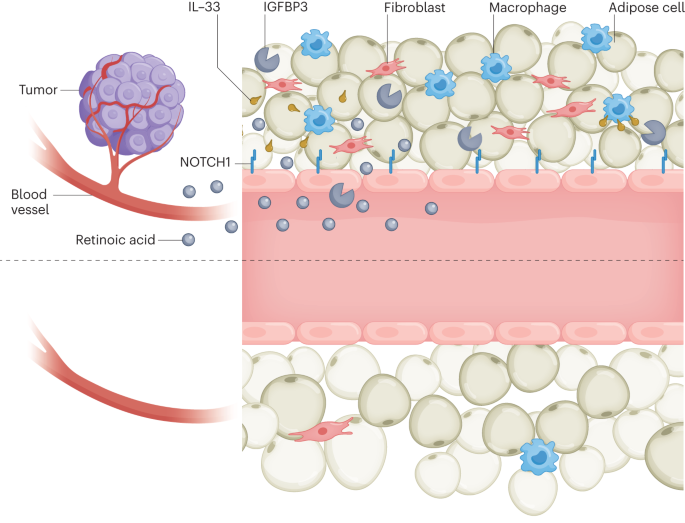
To investigate the potential contribution of IL-33 to RA production, ALDH activity was analyzed in myeloid cells from NICDiOE-EC mice (Extended Data Fig. 6h). Only macrophages (CD45+CD11b+F4/80hi) showed increased ALDH activity (Fig. 4e,f), and recombinant IL-33 directly increased Aldh1a2 expression in bone marrow-derived macrophages (BMDMs; Fig. 4g). Treatment with recombinant IL-33 induced ALDH1A2 mRNA expression in human WAT organoids differentiated from stromal vascular fraction (SVF) cells and increased ALDH activity in CD45+ immune cells (Extended Data Fig. 6i–l), thus confirming that this mechanism is not restricted to mouse cells. Mature adipocytes from NICDiOE-EC mice also exhibited increased Aldh1a2 expression (Extended Data Fig. 6m,n). This led to an increase in whole-tissue expression of RAR target genes (Extended Data Fig. 6o), suggesting that enhanced ALDH1 is not limited to ECs. Taken together, endothelial Notch1 induces ALDH1-mediated RA synthesis in the endothelium and further potentiates whole-tissue RA production through angiocrine-mediated IL-33 signaling by acting on macrophages and adipocytes (Fig. 4h).
RA regulates proapoptotic IGFBP3 in AT-ECsNext, we asked how enhanced RA production could be causative for WAT wasting. Both RA and IL-33 can act in a paracrine manner and are regulators of thermogenesis26,36,37. Ucp1 is a direct RAR transcriptional target38, while IL-33 induces a type 2 immune response, which promotes thermogenesis and is required for cold-induced WAT beiging in adult mice26. We could confirm that ATRA stimulates Ucp1 expression in a dose-dependent manner without any effect on other beiging markers (Extended Data Fig. 7a,b). Furthermore, ATRA and recombinant IL-33 both invoked gene expression of Arg1 in BMDMs (Extended Data Fig. 7c,d), which is similar to previous reports39,40.
Cachectic WAT loss is also mediated through adipocyte apoptosis and impaired adipogenesis5. IGFBP3 is a RARα target gene41 that inhibits adipogenesis and induces apoptosis in several cell types42. We observed IGFBP3 upregulation in human and mouse AT-ECs after Notch1 overactivation (Fig. 5a–d). Dose-dependent increases in IGFBP3 were also detected in human AT-ECs treated with ATRA (Fig. 5e–g), whereas inhibition of RAR-mediated transcription using BMS195614, a RARα antagonist, inhibited both classical RAR target genes and IGFBP3 expression (Fig. 5h and Extended Data Fig. 8a,b). Consistent with the observation that EC Notch1 induces Aldh1a2 expression in adjacent cell types (Fig. 4 and Extended Data Fig. 6f–o), adipocytes and whole sWAT of NICDiOE-EC mice also demonstrated increased Igfbp3 expression (Fig. 5i–l).
Fig. 5: RA-regulated IGFBP3 production induces WAT apoptosis.
a, RT–qPCR analysis of IGFBP3 mRNA levels in AdN1ICD-overexpressing human AT-ECs compared to AdGFP controls (n = 5 (vWAT ECs) or 9 (vWAT ECs) biologically independent experiments). b,c, Representative western blot (b) and quantification (c) of IGFBP3 protein levels normalized to VCP (n = 8 (vWAT ECs) or 12 (sWAT ECs) biologically independent experiments). d, Igfbp3 mRNA levels in NICDiOE-EC AT-ECs isolated from male mice at 2 weeks after tamoxifen treatment (n = 6 animals per group). e,f, RT–qPCR (e) and western blotting (f) of IGFBP3 in human AT-ECs treated with 0 nM (DMSO only), 10 nM, 100 nM or 1 µM ATRA. The western blot image is representative of three individual experiments; n = 3 biologically independent experiments. g, IGFBP3 protein levels were quantified relative to VCP (n = 3 biologically independent experiments). h, RT–qPCR analysis of IGFBP3 expression in human vWAT and sWAT ECs after treatment with 1, 2.5 or 5 µM RAR antagonist BMS195614 or DMSO (n = 3 biologically independent experiments). i,j, RT–qPCR analysis of
Comments (0)